
This article along with It Doesn’t Have to be this Hard by Victoria Gray and From the Labour of Survival to the Work of Art by Karl Kolley was commissioned to explore artists perspectives of success. Artists at different stages of their career, in different locations and with different lived experiences were selected from an open call to each write an article.
The article’s cover different experiences and share knowledge and advice that may support artists in furthering their understanding of success in the arts.
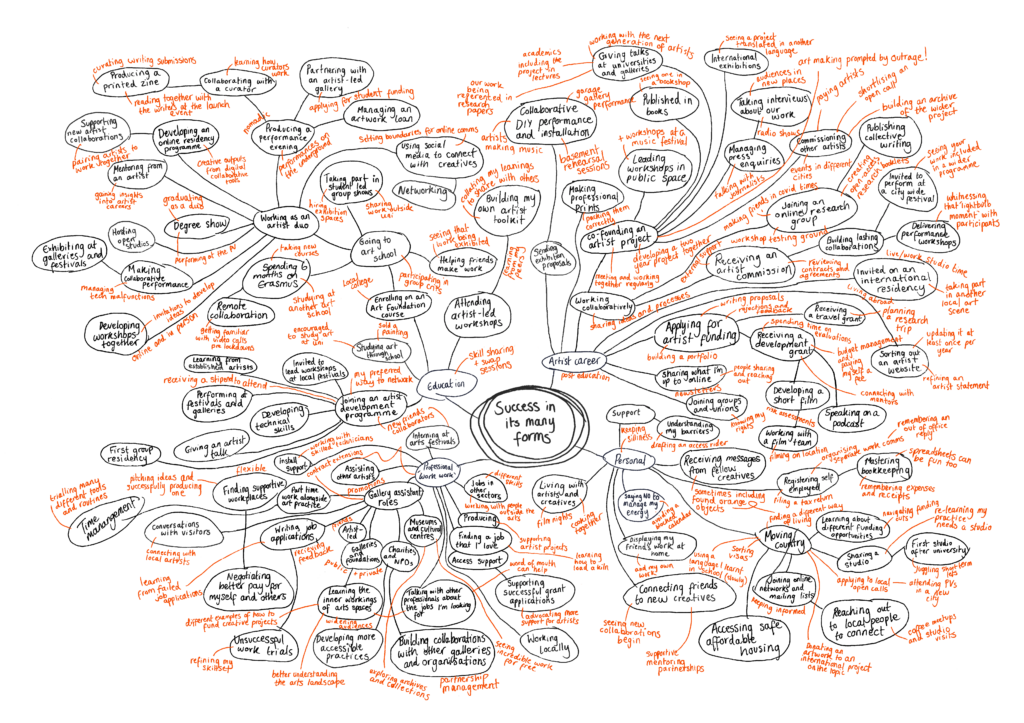
Success is a fickle friend and our relationship is in constant flux. I get a good dose of doubt, imposter syndrome and occasionally, anxiety flares in parallel with confidence, recognition and joy. It’s a push and pull, a constant negotiation, navigating the art world and everything beyond. But of course, even in spite of its ever-moving goal posts, I too feed off the highs of success, and I get motivated by the lows that keep me grounded and keep me moving forward.
For me, as an emerging artist nestled somewhere in the five to ten years after graduation, what might be considered typical artistic success has come in waves, often at what feels like completely unexpected times. But what do I mean by success here? Artist commissions, delivering workshops at large-scale institutions, group exhibitions and residency invitations, panel talks and publications…the things that you might feel deserve cementing in an artist CV or listing for your next application. Bit by bit, recognition for projects was piling up and with it, a sense of success. That’s what art school set us up for, right?
Whilst I face some barriers, I can’t ignore the building blocks I started on. Building a career as an artist was rarely challenged growing up and with an engaging school art department, encouraging family and role models in my orbit that I identify with, I learnt from the outset the complex support network needed to grow and develop. I had the support (emotional, financial, mentoring, housing) to attend art school and work professionally in London. Essentially, many different forms of support built the strong foundations of my identity as an artist.
Taking the idea of success very literally, press coverage and publications are a good chunk of how I understand ‘top tier’ success. I hadn’t considered a project I co-founded could be published in five books and receive wide international press. With books, publications and articles, they were giving me a different kind of seal of approval for the work. I was seeing the project reach new audiences and spaces I didn’t feel I had access to, out of reach with the resources I had at the time. I found it invaluable to understand my work through the lenses of others and in a wider context. It’s also nice to stumble upon a publication you’re included in, somewhere unexpected out in the wild.
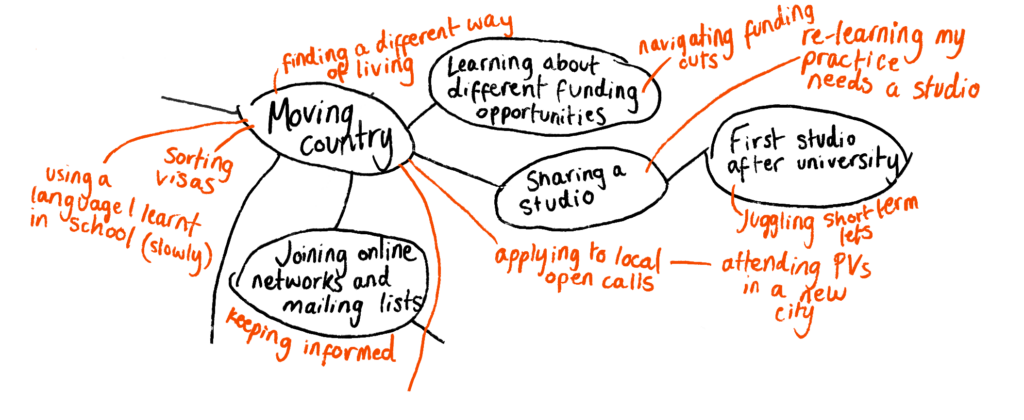
Writing about success in 2026 however, I find myself thinking about milestones more nuanced and why my understanding of success has shifted. What changed my perspective? Was there a single pivotal moment when my approach to success changed?Spending two months in Portugal on a residency played a big role; away from home, away from routine, the permission to havedifferent priorities. Of course, going on a residency isn’t the only way to achieve this; perhaps it’s as simple as having time to be an artist somewhere else was pivotal for me. I had time to re-evaluate my needs, my goals and how I work. Certainly, necessity (i.e., affordable safe housing) was a huge factor. It is by necessity that I later moved out of the city that birthed my artistic practice, networks, and circles of friends. I’m not saying London is an awful place, I’m just a bit jealous! I moved out because I couldn’t afford the time, space and support anymore. I’d had enough of trying to live in a place becoming unsustainable for artists.
But let’s be honest, moving to Berlin was never going to solve all my problems! Some would argue it’s no better. But craving the challenge of a new city (and some rent control) helped with the transition. Relocating certainly wasn’t an easy process, and it created new, different barriers for me to overcome in my day to day. New systems, different healthcare, learning German, all the whilst reading about the funding cuts, censorship and closure in the Berlin arts scene. Facing different challenges, I am reevaluating what success actually means to me. It’s a mixture now with the little things, like remembering to set an out of office reply, filing my first tax return in Germany and making time to attend a workshop. Success is a loaded word, and the little wins contribute just as much as the big ones.
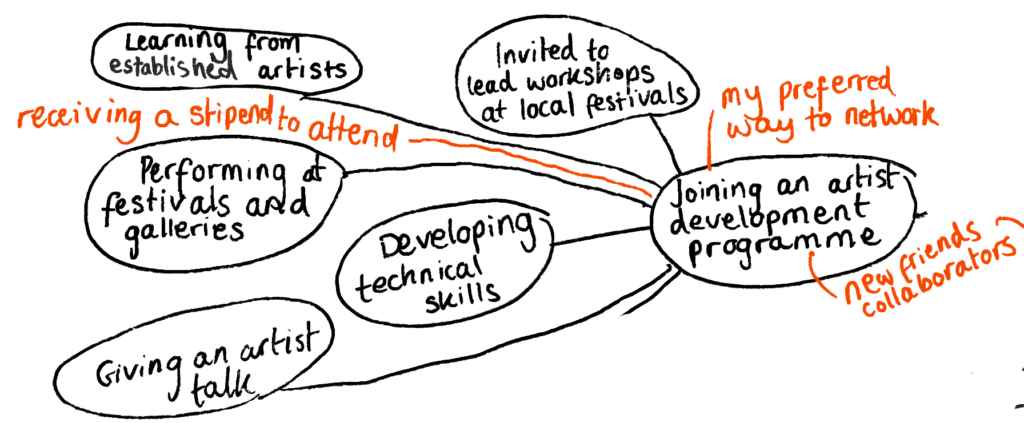
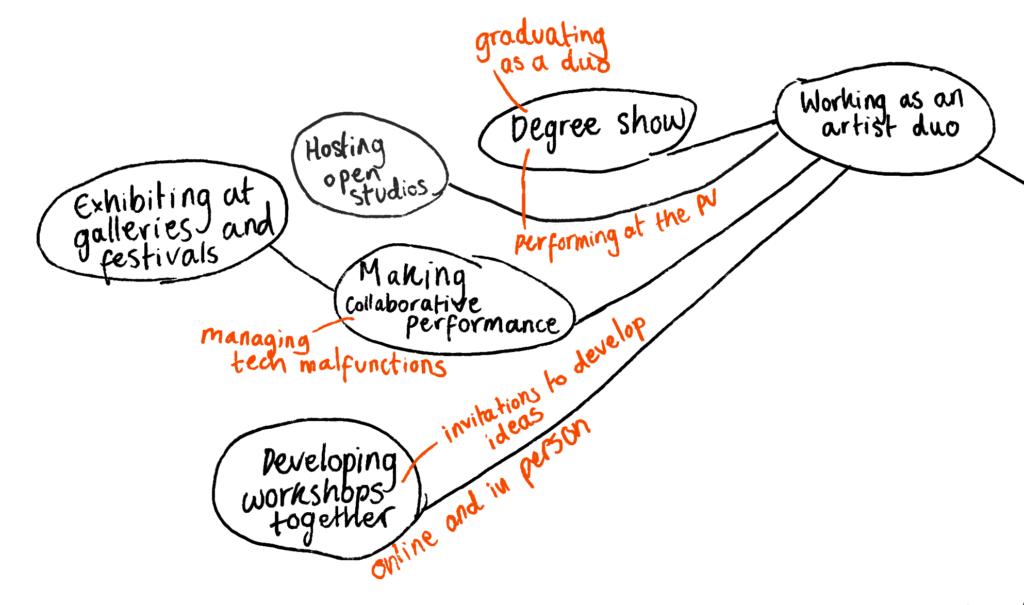
To help piece together my unruly understanding of success, I created a sprawling mind map, weaving together successes through these big and small wins. At first, what started as a list of opportunities and milestones, became a collection of connections, support, and lived experiences. It highlighted the incredibly juicy network of creatives I’m a part of, the support that has shaped my practice, and those little wins that show some of the inner workings of my practice.
A recurring theme in this web is collaboration. I am more and more viewing success in the communities and support systems we operate within, as artists, particularly having moved to a new city and needing to establish a new ‘local network’. In some ways I started over, and was given a fresh slate, ready to try again but this time with a more emancipated understanding of the art world, and how I want to be in it. What carried me through moving was the networks I’d built already and my renewed thirst for collaborative work and connection. Artist networks are a powerful thing!
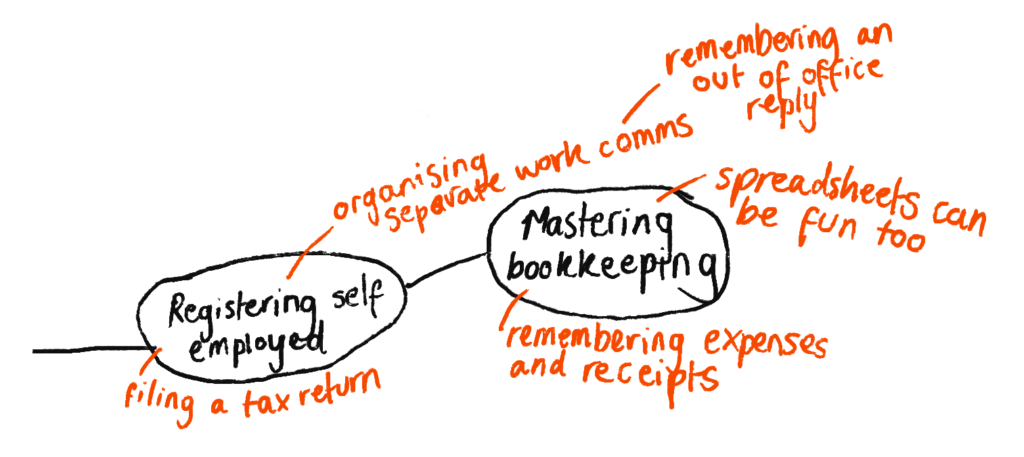
Perhaps instead of deeming success as unstable, fickle, it’s becoming this stretchy thing I keep re-moulding to fit with me. Flexible? Much like my art practice at the moment, it ebbs and flows as time and energy allows. What is deemed a successful career does not have an endless CV and regular new work, rather to me looks like a chaotic diagram of connections that show a clearer/bigger depth to successes. The role of creatives is incredibly important right now, especially in this beyond-words time for the world. The arts for me is ultimately about community building, a practice that now is more urgent than ever.
I read the following texts whilst writing this piece:
- Manifesto by Bernardine Evaristo
- The Carrier Bag Theory of Fiction by Ursula K Le Guin
- In Defense of Indefensible Expressions: On the Pure Complaint of Chronic Fatigue by Rouzbeh Shadpey
- The Beginning Comes After The End by Rebecca Solnit
Emily Roderick is an artist, producer and access worker making work that teeters between serious and silly. Creative outputs include performance, film, workshops, walks and writing. Current projects span church bells, surveillance tech and swimming noodles. Emily is a BA Fine Art graduate from Central Saint Martins in 2019 and now lives and works in Berlin.
The Dazzle Club received international press, exhibition and publication opportunities during the two year project (2019 – 2021). DYCP recipient from Arts Council England to research bell ringing, performance and community (2022). Participating artist in Vlatka Horvat’s By the Means at Hand, Croatia Pavilion at the Venice Biennale (2024). Selected participant for WHW Akademija in Zagreb (2024) and bpb x Genshagen Foundation Sumer Academy (2025). As a producer she supported the exhibition Crip Arté Spazio – The DAM in Venice with Shape Arts (2024) and continues to support accessible projects.