
This article along with Let Success be Stretchy by Emily Roderick and From the Labour of Survival to the Work of Art by Karl Kolley was commissioned to explore artists perspectives of success. Artists at different stages of their career, in different locations and with different lived experiences were selected from an open call to each write an article.
The article’s cover different experiences and share knowledge and advice that may support artists in furthering their understanding of success in the arts.
Let me set the scene. It’s December 2017, and I’ve just defended my PhD in Fine Art at Chelsea College of Art and Design. I enjoyed being a researcher and was proud of the developments in my art practice, but the PhD was fraught with personal challenges (more on that later), and it took me 6-years, instead of 3-years, to complete. Technically, I started the PhD in 2011, but the seed was sewn way back in 1997 on the first day of my BTEC National Diploma in Dance at Newcastle College.
To say that I was naïve and idealistic is an understatement. As a working-class kid, I was the first in my family to pursue post-16 education. Remember, this is 1997, the dawn of New Labour, Blairite upward mobility, and participation targets for FE and HE. I wasn’t just pursuing my artistic dreams; I was a pioneer.
I remember sitting on the floor of the dance studio whilst the tutor introduced herself and her academic achievements, including her PhD candidacy. “A PhD” I thought, “what’s that?” So, I put my hand up and asked. Looking back, it seems brave that I betrayed my ignorance and “outed” myself as the daughter of a welder and a civil servant, not an academic or an artist. I learned two things when I asked that question. My teacher said that a PhD was the highest qualification you could get and an undisputed marker of success in your field. As a chronically insecure and perfectionist kid, socialised into being a “good girl,” I was obviously going to need one of those to prove my worth.
I also learned that, from now on, it would be advantageous to mask my artworld ignorance (and my as yet undiagnosed autism). To pass as middle-class, art educated, and neurotypical would in itself be a mark of success. At the very least, if I could master this performance, it would significantly help me climb the (Blairite) ladder of success. I spent the next 2 decades dragging myself up that ladder (which felt more like crawling in a muddy ditch) and here is what I learned along the way.
It turns out I’m autistic. In 2017 (aged 34) just after completing my PhD, and after cyclical burnouts, chronic mental health challenges, and a lifelong sense of alienation, I finally received a diagnosis. This was a dual diagnosis and identified co-occurring Complex PTSD. Apart from feeling like I could have done with this information sooner, say, 20 years sooner, things started to make sense. I was relieved to know why my body-mind had been so chronically dysregulated since childhood. And it also helped me understand why, after 20+ years of slog in academia and the artworld, and after finally becoming an illustrious “Dr,” I still hadn’t achieved the “success” that my teachers and New Labour policy, way back in ’97, had promised me and others of my generation. I’d been lied to.
When this realisation dawned on me, I was sat on the living room floor of an overly priced rented house, having landed there after a 6-month period of being unhoused. I was also exhausted, since the night before, I’d been discharged from inpatient care after a serious mental health crisis. I had a PhD, but I was unemployed. I had a website that evidenced a body of artwork performed internationally, but I couldn’t leave my house. My upwardly mobile aspirations meant that I now lived in York, not Newcastle, and so with no family, and no support network, I was dependent on a social worker to visit daily to help me eat, take medications, and keep myself safe.
I had achieved everything I’d set out to achieve, did everything “they” said, but I had nothing to show for it. Worse still, I’d paid the highest price in search of success and validation. I’d sacrificed my health, my working-class identity, and connection to my autistic-self; but this cost wasn’t mentioned in the prospectus.
Sorry to paint such a bleak picture. Things have gotten much better. Let me reset the scene.
It’s February 2026, I’m sat at home (still rented), writing this article about how the definition of “success” has changed for me throughout my two-decade “career” as an artist. My PhD is in a drawer, somewhere, along with my autism diagnostic report, and I’m finally applying what I’ve learned in order to make my art practice sustainable; which is a very different goal to “making it” successful. Without the support I now have around me, I would almost certainly be living in boom-bust cycles of maniacal art making and then burnout. No exaggeration, I might not be here.
Being a “successful” artist looks something like this for me, these days…
I’m self-employed as an artist and 1-1 coach/mentor for neurodivergent creatives. Never again will I take a permanent contract with a university. It’s a false economy whereby it’s good for the money but bad for my health. Two resignations later, I know Higher Education doesn’t align with my core values.
I also know I can’t work “full-time,” so my Employment and Support Allowance supplements my income. My earnings are capped, but this is an economy that does make sense, because it prevents me from overworking and burning out.
I have Access to Work which has granted me the equipment I need to manage co-occurring physical health conditions (another story!), as well as a Workplace Coach who has been lifechanging in terms of supporting me to unmask, manage imposter syndrome, and set boundaries.
I have a “heart of gold” Work Coach at Job Centre Plus (who knew they existed!) who supported me to access Department for Work and Pensions funds to complete further coaching training and business support.
Sometimes I feel sad when I think back to the times that I had panic attacks before performances, hid in toilets at galleries to avoid social interactions, lied about having already eaten to avoid “communal artist lunches,” attended a Private View “just in case,” even though I was feeling non-verbal, or basically, said “yes” to an opportunity because I was seeking normative success and a CV boost, when my depleted body-mind was screaming “NO!”
I’m also kind of amazed I did it: the performance of a lifetime (which literally almost killed me).
When I started practicing as a professional artist in 2008, my idea of success was probably quite normative: gallery representation, regular exhibitions, recognition in the form of people writing about my work and working my way up the ranks of academia to become a Professor. I’m cringing confessing that, but it’s healthy to admit it, if only to see the stark contrast between what I’d imagined success would look like, aged 27, and what it looks like now, aged 44: sustaining part-time self-employed work, staying out of burnout, receiving state benefits, making work slowly, and only saying “yes” to an opportunity if it aligns with my values, my heart, and my access needs.
As well as my own work, my practice has expanded to include my 1-1 mentoring and coaching with neurodivergent creatives, which I see as an activist practice. It’s creative, it’s improvisatory, it’s collaborative. It’s art-orientated, not success-orientated, because as I’ve learned, they’re very different, almost opposing things. Success, for me, is creating a culture whereby art isn’t being put to uses that are at odds with its essence, and in turn, in conflict with our human capacity and wellbeing. With humility, I’d like this to be my artistic legacy, and I know it’s a healthy goal because it isn’t at odds with my autistic, disabled, working-class essence.
+
With the benefit of hindsight, it’s tempting to consider how I might have done things differently; a cinematic moment where I go back and advise my younger self (not that she would have heeded it) on alternative models of artistic success. It’s true to say that, had I not experienced all that I’ve shared in this article (and more), I wouldn’t have gained the particular insights and intersectional lived experiences that are core to my values. I’m reluctant to romanticise (my) struggle, particularly because it risks perpetuating some kind of Hero’s Journey. However, there’s a pivotal moment that keeps coming to mind, one that helped me reorientate my (skewed) inner compass from success to self-compassion.
It was 2015, I was mid-PhD, and fulfilling a long-held “ambition” to present my performance work at VIVA Art Action, in Montreal Canada. After the performance, a member of the audience, completely unsolicited, approached me and said, “Victoria, it doesn’t have to be this hard.” Notice, they didn’t comment on whether the work was good, or bad. Just that “it” didn’t have to be this hard. I’m still grappling with that moment, and why they felt compelled to say it to me in the first place.
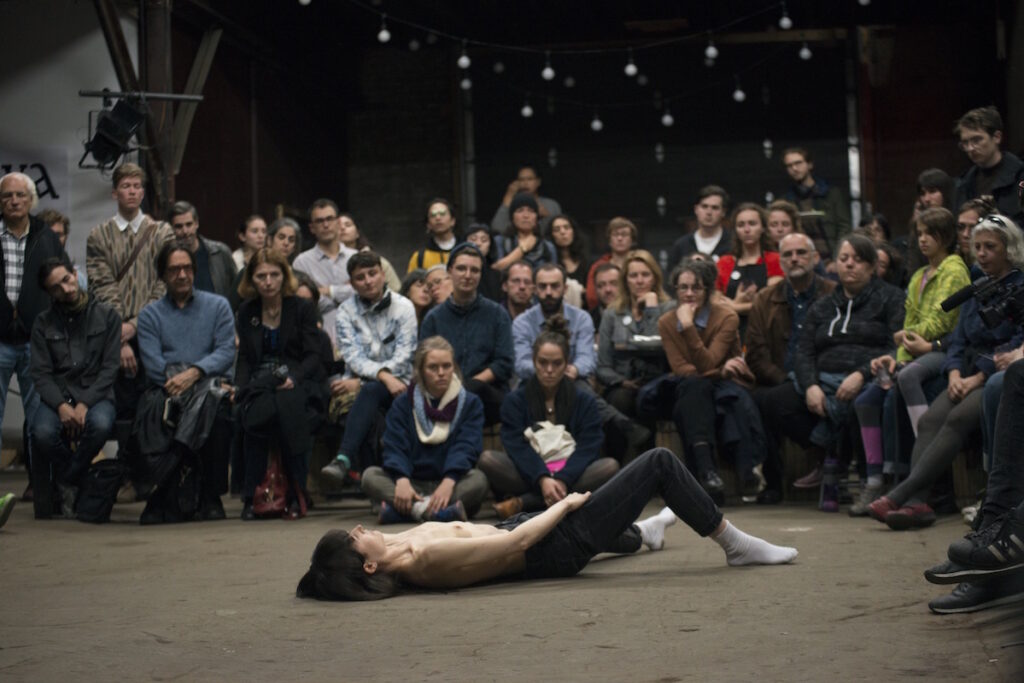
At that time, the only thing that matched the veracity of my artistic ambition, sadly, was my complex mental health issues, which, until that audience member approached me, I thought I’d successfully masked. Ironically, I felt I was making my ‘best’ work, yet my physical and mental wellbeing was at its ‘worst.’ A fitting analogy is that I was like a plug without an earth wire. I was living in the high-dopamine, high-masking, electric shock of (sometimes, dangerously) live performance. And, as a first-generation university art graduate from a working-class family, the socio-cultural mantra (dogma) was that hard work – aka the myth of meritocracy – would win out. Moreover, that working hard at any cost to your wellbeing, and let’s face it, usually for free, is an innate moral good, nay precondition of being a real artist.
Let’s say I did go back to my younger self, what might I say? Perhaps I’d approach myself with the compassion of the audience member in Montreal, and say, “Victoria, it doesn’t have to be hard,” instead of threatening myself with, “Victoria, you have to work hard” to achieve success. At the very least, this turn of phrase might perform some powerful reorientation: I’d be wired to value (self) compassion, rather than success, which I believe is the most we could ask for as artists and humans. When I work 1-1 with neurodivergent artists, this is a core value we cultivate together; a commitment to making work from a place of curiosity and compassion, not fear of failure.
To the working class, neurodivergent, artists out there reading this, maybe you’re high-masking, experiencing burnout and anxiety. Maybe you’re feeling disillusioned and excluded, since, after all that hard work, your ethics and practice are at odds with the very art world you’ve spent so long qualifying to participate in. In my experience, this feeling starts as a hunch. A nagging feeling that something doesn’t feel right, but one you feel ashamed to admit to yourself and your peers. Listen to that voice, carefully. Like the wise audience member in Montreal, that internal voice is saying: You don’t have to be hard on yourself, or others. You don’t have to harden yourself to be a success. “It doesn’t have to be this hard.”
Victoria Gray [b.1982] is an artist and practice-led researcher and has presented work in the UK, Europe, USA and Canada. With an initial conservatoire training in dance and somatic practice her primary medium and material is the body. She has a PhD from Chelsea College of Art & Design London, at the intersection of somatics, process philosophy, and Fine Art. Her current artistic research is orientated within the field of autistic perception and somatics.
She is currently training with Embody Move on the Somatic Movement Education (SME) programme (kindly funded by Dancers’ Career Development). As an independent academic, she delivers on BA, MA and PhD performance courses by invitation, as well as working privately and within HE as a specialist mentor and coach to neurodivergent researchers and artists.