
About this article
This article was written by Rosalind Davis one of the long-term advisors on the Artquest One-to-One programme. Artquest One-to-One’s saw Artquest staff and professional career advisors deliver 30 free one-to-ones online each month. With the One-to-One programme being paused we invited the advisors to write an article that focused on some of the most questions they were most frequently asked by artists. Rosalind has written a short article on How to Write an Artist statement. Sophia Kosmaoglou, another of the advisors, has written an article on how artists can give peer-to-peer feedback through one-to-one sessions and self-organise.
An artist’s statement is often thought of as one of the most difficult aspects of being an artist and artists regularly express their struggles with it, which is understandable. Artists are predominantly visual people. It can be tricky to articulate your practice but it’s necessary. An artist statement is required for all sorts of opportunities including exhibiting, funding, residency, proposals and working with curators and galleries, and they are taken seriously. A poorly written statement can be a real deal breaker in a very competitive art world. Your statement is a chance to represent yourself which is a positive thing, to stand behind your work in all its aspects and feel confident in doing so.
Often a variety of responses I get from artists about writing a statement is; ‘But I want to leave it up to the viewer….’, ‘I don’t want to pin it down/ be boxed in’ etc. A statement isn’t about pigeonholing yourself or leaving it up to others to interpret, it’s as much for you as anyone else. It can’t just be a throwaway text that you do at the last minute before an opportunity, I have seen thousands of statements that indicate that is what has happened or that the artist has not put enough time or thought into it – often out of lack of understanding about how to address it.
Why you need a statement
Firstly, it is important to engage people with the ideas behind your work, both on and offline in an informative way, providing insight into your work and articulating the things that your images cannot – perhaps the story behind the making of the work for example.
It is your chance to shape people’s opinions and interpretations of your work, allowing engagement with audiences, whether public, curators, galleries and fellow peers and therefore also help in building relationships. No one is trying to catch you out; it is merely a tool to aid understanding.
It also helps you to reflect on your practice, where it has come from and how it may be developing, to think about your influences, peers, context/place in art world and process.
Finally, a well written statement presents an organised & professional profile and shows you are also engaged with the concepts in your work.
These are all good reasons to address the statement. If you no longer see it as an obstacle but instead an opportunity to articulate yourself, it will also help you to build your confidence and improve your practice by drilling down into your subject matter.
What’s your work about?
To begin with, ask yourself some questions to start and I recommend even if you have a statement, it’s always good to review it regularly throughout your career to ensure its up to date and reflective of your current work.
Not everything you consider will go into your statement from these questions or the exercise suggested here, but it’s a good way to start analysing your work and make sure the statement feels authentic to you first and foremost.
- What are your overarching themes – what are the key drivers for you to make the work? This may involve an evaluation of your processes and work to really understand what your motivations are and what compels you to make art.
- How do you want the world to connect with your work / How do you interpret /view the world around you?
- Does the work have an agenda?
- What connects you to your work?
What do you see in your work?
Set a timer for 15 minutes to start with and write down everything you see your work as, thematically, aesthetically, emotionally, be descriptive, remember to write down what materials and processes you use.Be creative and expansive. Use a thesaurus.
Consider the above questions circle at least three of the strongest words you most identify with that are associated with your practice. For example; architecture, experiential, installation.
Artist statement – general structure
An example for a short statement would be: 3 paragraphs, the first is an introductory overview of the work, the second giving more specific examples of the work – processes and materials for example, the third a concluding paragraph drawing your ideas together. This is not a set rule, but it is good to set out a structure for yourself to help make sense of what you are saying and where you are saying it.
- Opening sentence = summary of work (using those 3 strong words in this first paragraph).
- Outline your themes or subject matter and why is this important to you?
- Describe what is it? Figurative, landscape, installation, video, performance, sound, ceramic, textiles, multi-disciplinary etc? Why?
- What is it made of or constructed with: mediums / materials? Is it site specific etc?
- How is it made? The beginning point could be important here– the process of making.
- You can detail specific works / projects / or series.
- Is the size/ scale /length/ or time important to the work? And why?
- Is colour or surface important? And why?
- Where are you going with your ideas? Are issues of identity or Ecology important for instance. These thematic concerns could be required for a particular opportunity but are also important questions for you to think about.
- What do you want the viewer to think about when encountering your work?
- The concluding paragraph of a statement functions to draw the threads together – summarising overarching ideas / how ideas are communicated through materials & processes described above.
Context of the artist statement
Asking yourself ‘why’ questions are helpful. Everyone’s why’s are different.
Not everything above will necessarily go into your final statement, but it is useful to really drill down into all aspects of your work… And then you, a peer or mentor can begin to edit and refine this process in discussion. Asking someone you trust to read your statement, and give constructive feedback is an invaluable measure of whether your statement accurately reflects your work or adds to its experience.
In addition, it is helpful to understand your context; educate yourself on your subject area. What are the historical precedents? What are the contemporary precedents? Ie Whose work do you identify with, who’s on the same pitch or territory? How do they articulate themselves? How does your work extend these areas of enquiry?
Write about your work. It’s not a marketing text to sell your work or a dissertation. It needs to be comprehensive and understandable but not too basic. Try to keep your language simple and straight forward, avoiding art-speak, cliché or generic words. There are overused phrases such as ‘my work explores..’. Try to avoid praising your own work but including a quote from someone else can be useful positive commentary. Writing in the third person is generally best for exhibition opportunities as that’s the standard, however again with a residency or funding bid it would be first person.
Always check punctuation, grammar & spelling! Autocorrect can be fantastic but also sometimes incorrect!
Editing your artist statement
For some it is incredibly helpful to speak into voice memos instead to verbalise their thoughts more freely – try answering the questions outlined above this way. There are great resources such as Grammarly that can help to clarify your writing, assimilate repetition and provide alternate phrasing, but be aware that your text still makes sense and most importantly – is still in your own voice. AI tools may not understand or communicate the personality or idiosyncrasies of your ideas.
The length of a statement is usually around a page maximum, but you may need different length versions of it dependent on the opportunity. You may want a page long version and one in a single 100 word or 250-word paragraph.
And… your statement evolves! As you and your work change you will need to edit and over time revisit, reshape and create different versions for alternate opportunities. You might need to emphasise a particular piece of work, project, collection, collaboration etc. You are also the best person to write about your work, even with some guidance or help, as you know best why you make your work.
It does take time to achieve the right balance, tone, depth and comprehensibility but if you put the time in, take on board some of the advice here, you will get there. Remember, like you, your work and the statement are a continual work in progress.
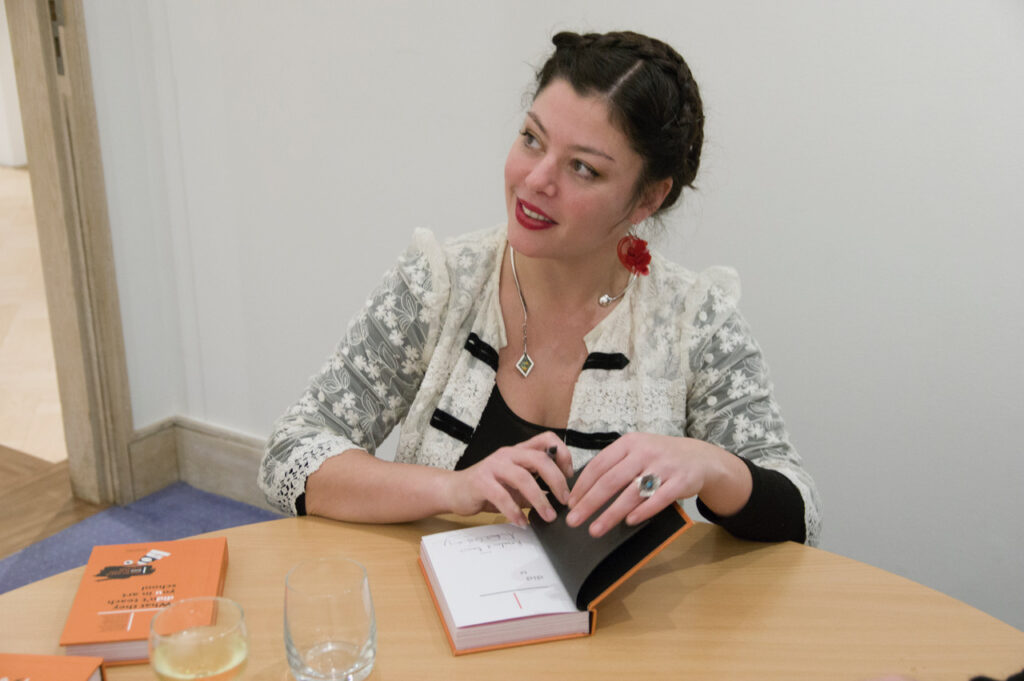
Rosalind Davis
Rosalind is a curator, art consultant, artist, and writer. Her art practice includes painting and installation and she has exhibited int he UK and abroad. She is a graduate of The Royal College of Art and Chelsea College of Art. She was Curator at Collyer Bristow Gallery and founded Zeitgeist Arts Projects and Core Gallery. She has curated over 30 exhibitions.
Rosalind is co-author of the book What they didn’t teach you at art school. She lectures at universities, galleries, and arts organisations across the country like the Royal College of Art, Firstsite Gallery, The De Le Warr Pavilion, ICA, Camden Arts Centre, and UAL. She has been an independent artist mentor for over 10 years and also for a-n, Artquest, Shape Arts, The Independent Art School, Plop, and UK New Artists. She has also worked as a consultant for arts organisations, charities, and corporations such as BBC4 and E4.