
Art practice is sustained by the support that artists provide for each other – long before recognition and institutions come into view.
In everyday exchanges, artists develop their practice through shared language and collective inquiry. This article provides insight and guidance around peer mentoring and how forms of peer support are fundamental to wider questions of success, autonomy and self-organisation.
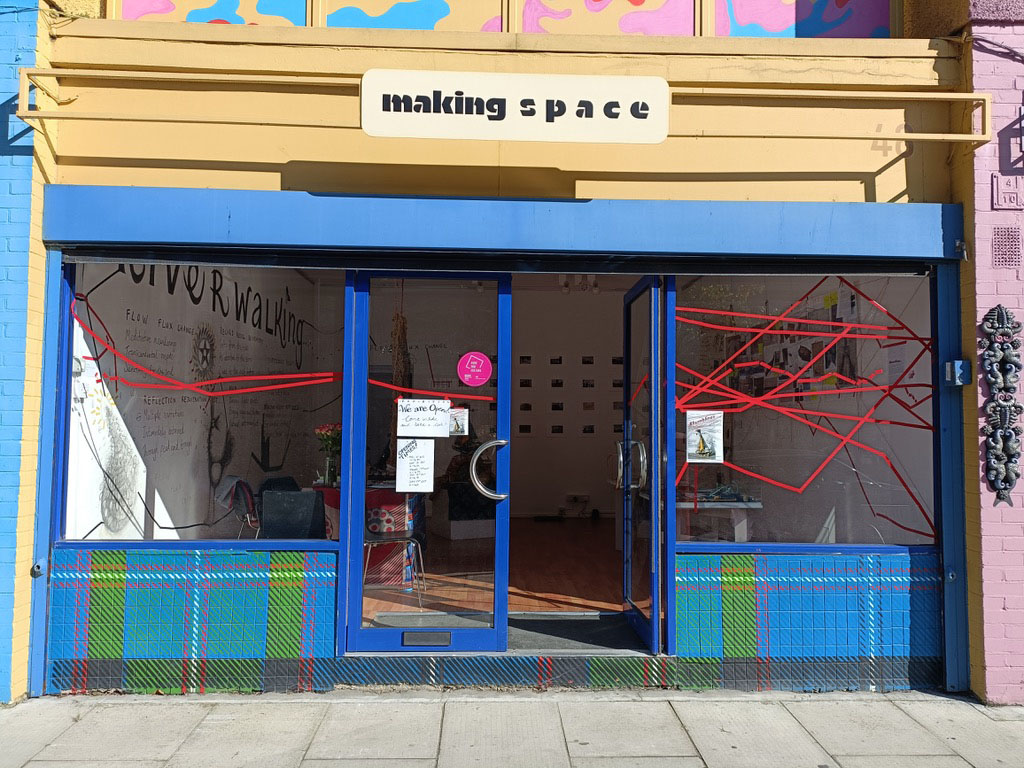
The question comes up over again: “How do I make it in the art world?” Often behind it are the myths and expectations of being ‘discovered’. The desire for recognition is like waiting for an invitation to your own life. But why crash someone else’s party when you can throw your own? You’re late to that party anyway. You get to decide how to throw your own party as a protagonist in your story, rather than a guest in someone else’s.
And what is a party without mates? Creating your own conditions, together with others, can begin with a crit group, a zine, a reading group, or a festival – something that arises directly from the work and its needs. Collaboration produces relationships that generate new ideas, opportunities, and ways of thinking. Over time, these conversations and shared projects form the fabric of a more resilient practice: one sustained by dialogue and solidarity, rather than validation and competition.
Peer mentoring as practice
From group crits to one-to-ones, peer review doesn’t offer neat answers or well-intentioned praise. Peer mentoring is about responsiveness rather than authority; it involves co-construction, listening, responding and articulating.
All the questions that artists ask when seeking feedback can be boiled down to: “Am I on the right track?” A good one-to-one will provide that reassurance indirectly, but it will be grounded in the specificity of the work and the issues at stake.
A checklist for peer support
Below is a checklist you can use to build your own peer mentoring group or mutual support network:
- Listen first. Reflect what you hear in your own words.
- Avoid interruption. Allow space for thinking aloud. Allow uncomfortable pauses and silences. Silence is also a form of communication.
- Name the strengths and potentials of the work before offering critique.
- Explore and brainstorm the work.
- Focus on the work, not the artist.
- Ask questions rather than providing answers.
Questions to ask in a peer feedback session
- What do you see, hear, feel in this work? Describe the work as you perceive it. This is very valuable and informative feedback for an artist. The terms you use in your description may resonate with the artist, or bring a whole new dimension to the work.
- What resonates with you? Liz Lerman calls this step ‘Statements of Meaning’: what does the work mean to you? What associations and emotions does it conjure? There is nothing more intimidating than articulating our subjective perceptions. One reason for this is the difficulty of translating sensations into language, but that is what engaging in artistic discourse involves.
- What questions is the work asking? What aesthetic or formal concerns does the work engage with? What themes does it grapple with? What influences can you identify?
- What feels unresolved?
- How does the work relate to the artist’s stated intentions?
DIY models, formats & practical steps
Throwing your own party begins with recognising what your work needs and building those conditions yourself. The form should arise from the work itself: what questions is it asking, and what kind of encounter does it require? Sometimes the work needs a space of exchange rather than display.
There are as many ways to throw your own party as there are practices. You might organise an exhibition – transforming a studio, living room or warehouse into a temporary public space. You might curate a screening or performance night, borrowing equipment, or collaborate with local venues. A crit group or reading circle can create a rhythm of dialogue and accountability. A zine, newsletter or podcast can extend this conversation beyond your immediate circle, sharing resources and works-in-progress. You might organise a pop-up event or festival, combining visibility with community exchange.
Start where you are. One or two collaborators are enough. Keep it small and responsive; let it evolve with each iteration. Use the resources already around you: skills, time, contacts, spaces and mutual goodwill. Document what you do so that others can learn from it.
Don’t be afraid to include yourself. Many artists worry that organising and including themselves will look self-promotional. But excluding yourself can be a way of deferring the risk of showing your work. Exhibiting your work is always a challenge and a disclosure, but including yourself provokes a response and encourages others to do the same.
The examples above show what’s possible; the checklist below turns those ideas into an action plan. Start by defining what you want to do, who it’s for, and what it needs. The steps that follow are an adaptable framework for putting your idea into practice.
Getting started: practical steps
- Clarify the impulse
Ask what your work needs right now: feedback, visibility, dialogue, collaboration, space? The format should emerge from that need. - Find allies
One or two peers are enough to begin. Collectives grow from conversation, not recruitment drives. - Start small and visible
Pilot one event, publication or meeting, using what’s already available – your studio, a café, a social centre, or online. - Share the labour
Divide tasks openly: organising, documentation, communication, installation, hospitality. Rotate roles to prevent burnout. - Document and reflect
Keep notes, photos or documents. Reflection turns experience into shared knowledge and helps others build on what you’ve done. - Communication tools
Communication is the structure that holds everything together: how ideas circulate, decisions are made, and relationships are sustained over time. The tools you choose shape access, participation, and visibility. Choose tools that fit your scale and the rhythms of your collaboration – informal channels for small groups, shared documents for ongoing work, and public platforms to document the process and extend the conversation. - Invite others in
Once momentum builds, open the circle. Publicise through word of mouth, social media or newsletters. - Build continuity
Set the next date before the first event ends, or on a regular day every month. Consistency, however modest, transforms an occasion into a structure. - Stay responsive
Let the project evolve with the people and circumstances around it. Don’t institutionalise too early.
Organising together: power, structure, ownership
Joining groups & networks
Joining an existing group or network is one way to learn how a scene actually functions. Sometimes that means volunteering, contributing to a shared project, or just showing up consistently. These are not peripheral activities; they are how relationships, trust, and shared reference points are formed over time.
The art world is structured through cliques – informal groups that shape access, visibility, and opportunity. Affinity groups are rarely deliberate or closed by design; they form through repeated interaction, shared projects, and accumulated trust. Access tends to follow proximity and familiarity rather than meritocracy. What looks opaque from the outside becomes legible once you see how participation over time produces belonging, influence, and responsibility.
Every network, from artist-led collectives to major institutions, develops its own ecosystem. Labour is distributed unevenly, recognition concentrates, care and maintenance often go uncredited. Look for groups with values that align with your own, pay attention to how they operate: How is labour shared? Who gains visibility or credit? How are decisions made? These mechanisms shape how power and influence circulate within a scene. The closer you are to decision-making, the more agency you have to shape outcomes – and the more responsibility you carry for how those outcomes affect others.
Self-organisation
Once you find the right partners, the next question is what kind of organisation you want to build: a one-off project with a few trusted collaborators, or a structure that can grow and include others? Working with friends can accelerate momentum, but it can also reproduce unspoken hierarchies. An equitable structure takes longer because it requires shared infrastructures for communication, accountability and care.
Self-organisation involves building structures with intentionality. In her influential article The Tyranny of Structurelessness (1970), Jo Freeman argued that ‘structurelessness’ conceals informal power and makes it harder to address. Agency and leadership can be distributed, decisions can be made collectively, and responsibilities can be shared without dissolving accountability. This requires time, communication, and patience.
Artist co-ops
Cooperation is a set of practical tools to carve out spaces of freedom and self-determination. Shared ownership empowers new forms of social and artistic organisation, risk and decision-making, redistributing labour and power. Co-ops sit within a broader solidarity economy that includes worker collectives, social centres and mutual-aid networks.
In Together (2012), Richard Sennett argues that co-operation is a craft that must be learned and practised, not an instinct we can take for granted. Cooperation involves listening, sharing responsibility, and allowing space for disagreement.
Weakened by competition, inequality and individualism, cooperation can be relearned through shared practice. Building a co-operative or collective is one way to reclaim that craft. The work of the Social Science Centre (2011-19) in Lincoln, Feral Art School (2018) in Hull, and the Ceramics Studio Co-op (2014) in Deptford, demonstrates that we don’t need to reproduce the university to learn together, just as we don’t need a museum to make art public. The co-operative model is not just an institutional format, but a pedagogy in democratic decision-making and shared authorship.
How to keep going
Every self-organised project reaches a point where the question shifts from how to start to how to keep going. Sustainability requires flexibility: knowing when to pause, adapt, or change direction. Trust underpins everything here: relationships, continuity, and momentum.
- Keep the network active
Stay in touch: with updates, invitations, or check-ins. - Share resources
Pool what you have: equipment, skills, contacts, mailing lists, funding applications. Mutual aid keeps everyone’s practice going longer than individual effort. - Rotate roles and responsibilities
Shared projects survive when leadership moves around. Rotate tasks, budgets and credit. Everyone learns more, and no one burns out. - Build care into the structure
Decisions, deadlines and expectations should leave room for life. Sustainability comes from reciprocity, not endurance. - Review and renew
Take time to reflect on what’s working and what isn’t. Projects that last often shift – from an exhibition series to a collective, from a collective to a co-op. Let things evolve. - Know when to close
Not every initiative needs to last forever. Ending well, with transparency and care, can be part of its success. Leave people connected and ready for the next thing.
Artists don’t need official frameworks. Throw your own party and invite others. Share the work. Share the load. Build the relationships and communities that will sustain you.
Resources
Peer mentorship
Resources on building and sustaining peer mentorship:
- Building a peer mentoring group
- Artist Peer Support Groups by Chloe Cooper
- Juggernauts’ Guide to Peer Mentoring
- Crit Club by Rosalind Wilson and Eleni Papazoglou
- Liz Lerman’s Critical Response Process: The Basics
Self-organisation
- Freeman, Jo (1970). The Tyranny of Structurelessness. Updated version. Originally published in Second Wave vol. 2, no. 1 (1972), pp. 1-6.
- Exploding Cinema (2004). Make Your Own Underground Cinema.
- Bibliography on self-organisation. Includes collaboration, collectivity, co-operation, group dynamics, DIY, peer-to-peer networks, solidarity economy, and study groups.
Artist coops
- Art.coop (2021), USA.
- Ceramics Studio Co-op (2014), London.
- Feral Art School (2018), Hull.
- Kosmaoglou, Sophia (2023). A co-operative art school is pie in the sky. In Towards New Schools. Gerrit Rietveld Academie (Dec 2023). A guide on setting up a cooperative art school.
- Resources for a Co-operative Art School (2019-ongoing). Includes resources on alternative art education.
- Bibliography for a Co-operative Art School (2019-ongoing). Includes sections on alternative art education, art education and pedagogy.
- Directory of Alternative (Art) Schools & Networks (2017-ongoing). Includes, peer support networks, projects and vanguards of the alternative education movement.
- A co-operative art school? (2019-20) Research project on cooperative art education. Artquest Research Residency at the Conway Hall Humanist Library.
Download full article
About this article
This article was written by Sophia Kosmaoglou, a long-term advisor on the former Artquest One to One programme. At the end of the Artquest One to One programme in 2025, we invited regular advisors to reflect on some of the questions they were most frequently asked by artists. Rosalind Davis, another of the advisors, has written an article on how to write an artist statement.
Sophia Kosmaoglou is an artist, organiser and educator working across art practice, critical pedagogy and collective organising. Her work explores collaboration, interpretation, autonomy and the social conditions of art-making, often through research-led and self-organised formats. She is the founder of ART&CRITIQUE and co-founder of the Radical Pedagogy Research Group, and teaches studio practice, critical studies and curating in higher education and independent contexts. She holds a practice-based PhD in Fine Art from Goldsmiths and worked as an Artist Advisor at Artquest. She is currently developing a co-operative art school as a self-organised alternative to mainstream art education.